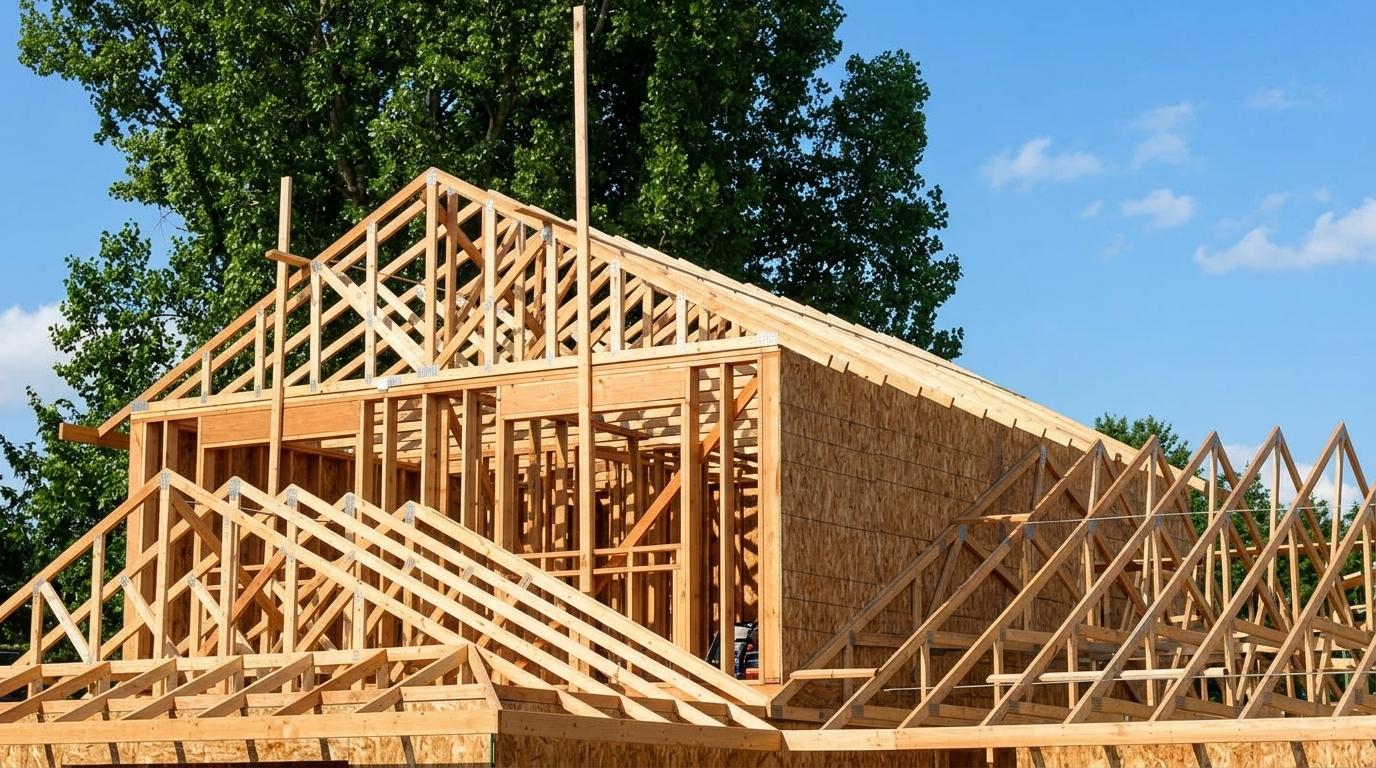
Planning a new home or an addition? A roof truss is the structural framework that supports the roof and transfers its loads to the walls.
The type you need depends on your roof shape, span, ceiling design, expected loads, and budget.
This guide explains the main roof truss types in plain language. You will learn what each truss does, where it works best, how wood compares with steel, what typical costs look like, and which site conditions can affect the design.
By the end, you can compare the main options before discussing your plans with a truss manufacturer, structural engineer, architect, or builder.
What a Truss Does to Your Roof, Budget, and Floor Plan
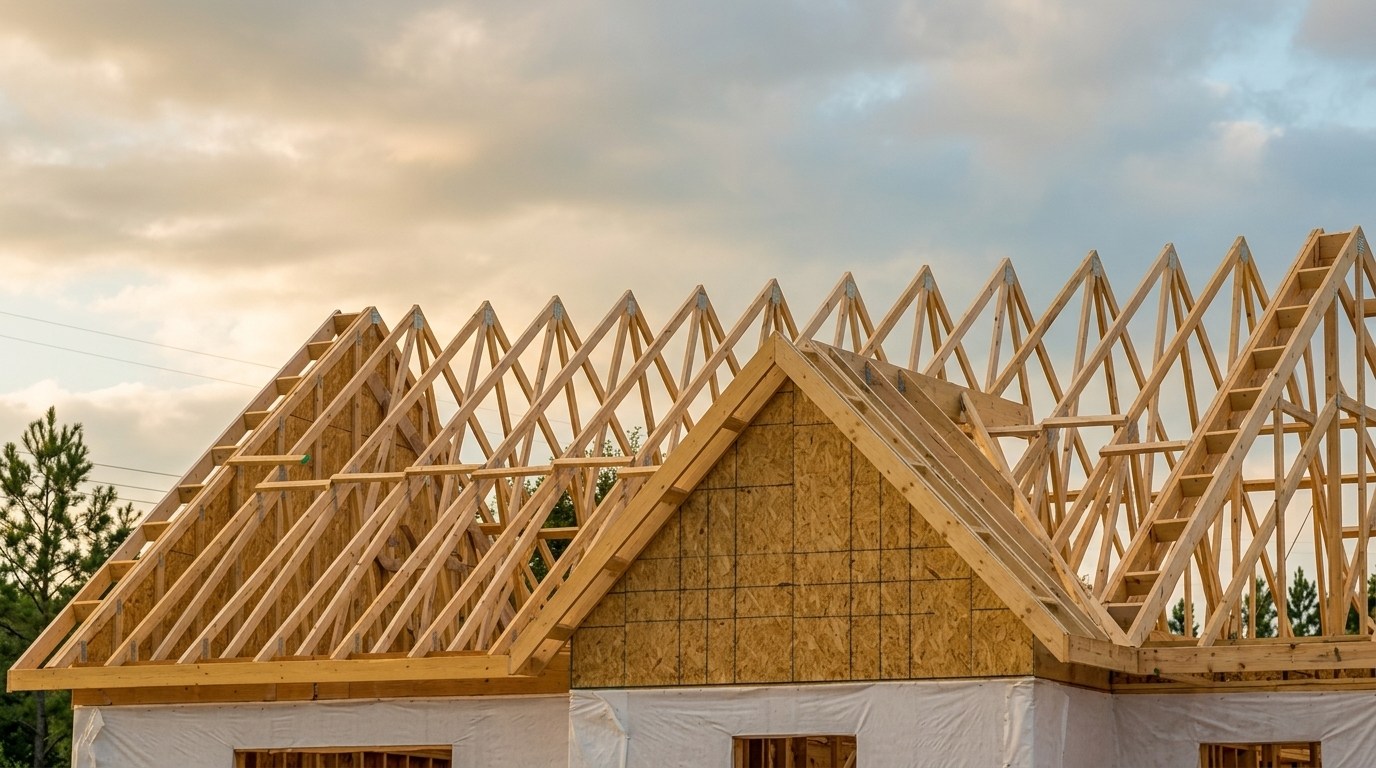
A roof truss carries the weight of the roof covering, sheathing, ceiling materials, and other permanent loads. It also carries temporary loads such as people, maintenance loads, wind, and snow where those conditions apply.
The truss transfers these forces through its members to the supporting walls, helping keep the roof stable.
Trusses can also reduce the need for interior load-bearing walls, which gives designers more freedom with room layouts. However,the truss design cannot be selected from the roof shape alone because the final design must match the actual loads and building conditions.
The exact responsibility for preparing and approving truss drawings depends on the project and local requirements.
Current sources point tolabor built (stick framed) rafters costing more than factory built trussesin most cases.
Trusses typically cost 30 to 50 percent less than rafters for the same roof area due to reduced labor and efficient material use. Rafters are cut and assembled on site by skilled carpenters, and this hands-on process takes far longer than setting a prefabricated truss.
Anatomy of a Truss: The Parts You'll See on Every Drawing
Before comparing truss types, it helps to know the basic parts. These terms appear on truss drawings and make it easier to understand how different designs carry loads.
Chords, Webs, and Heel

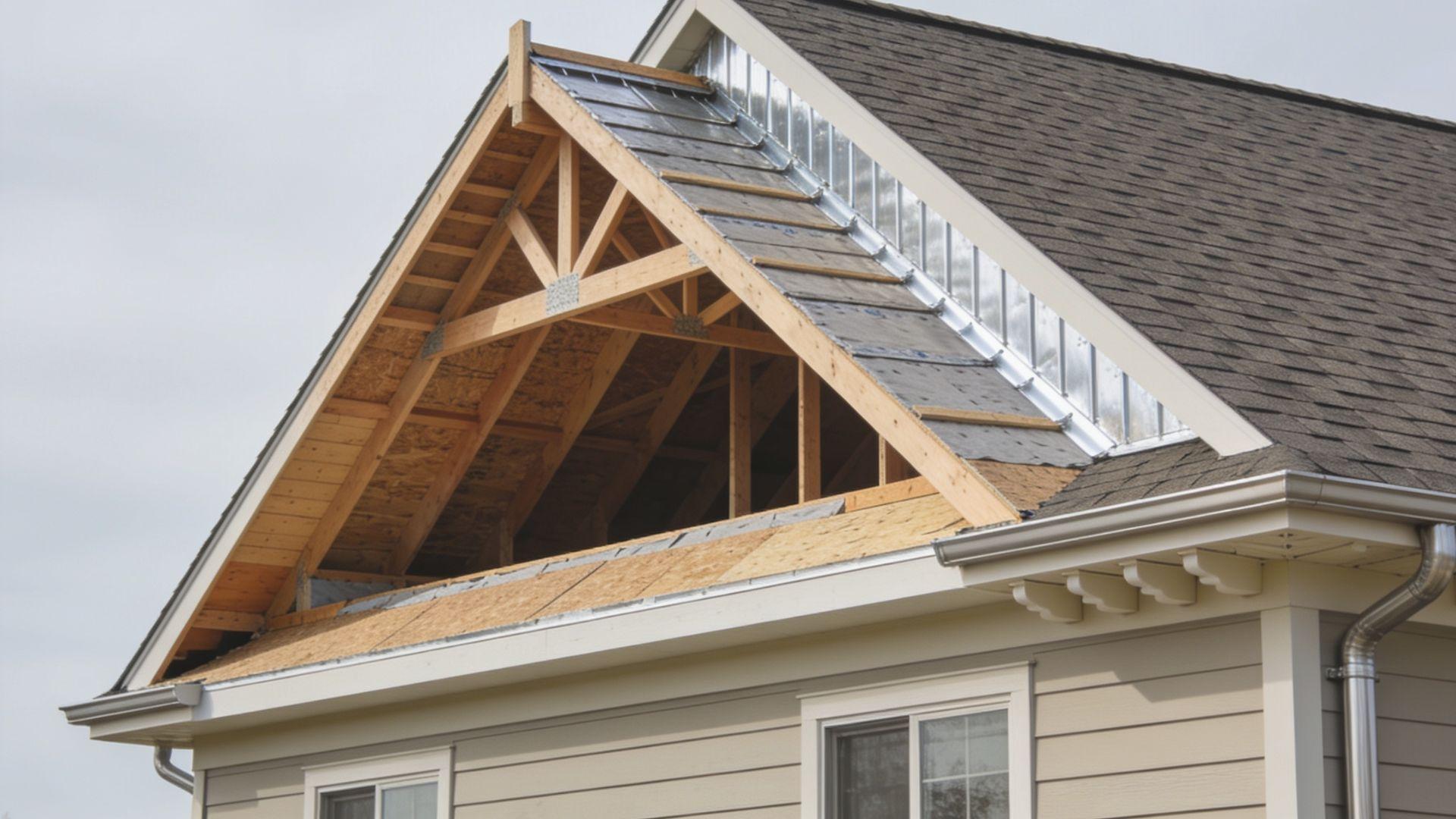
The top chord forms the sloped upper edge of the truss.
The bottom chord runs along the base and is often flat, while web members connect the two chords and form the internal triangular pattern.
The heel is where the top and bottom chords meet near the outside wall, while the peak is where the sloped top chords meet.
Chord and web sizes depend on the required design and may use lumber such as 2×4 or 2×6 members.
Span, Pitch, and Spacing Explained
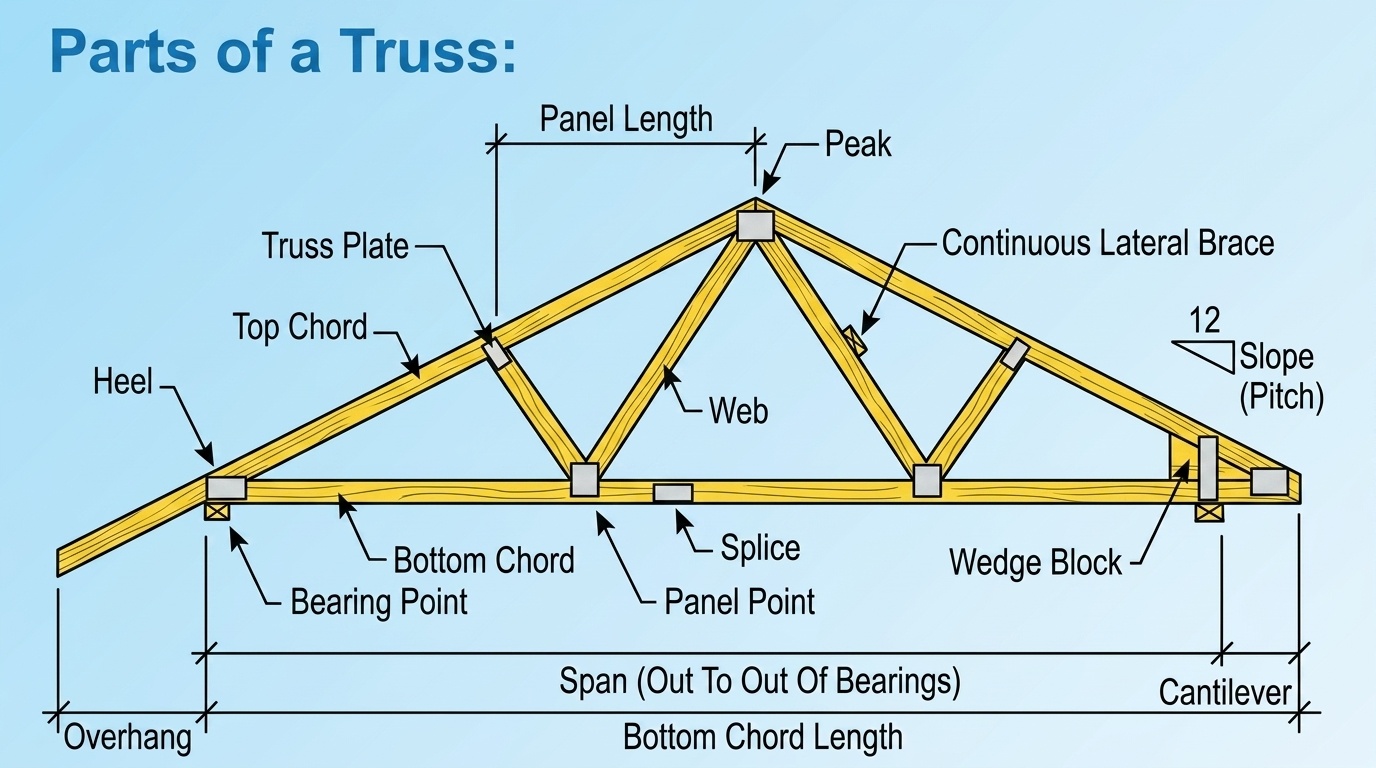
Span is the distance between the truss bearing points.
Pitch describes roof steepness using rise over a 12-inch horizontal run, so a 6/12 roof rises 6 inches for every 12 inches of horizontal distance.
Spacing is the distance between adjacent trusses.
Common residential layouts may use 16 or 24 inches on center, but the required spacing depends on the design and loads. Truss drawings must account for the applicable code requirements and design conditions.
Simple Post Trusses for Small Spans
Simple post trusses use a basic arrangement of chords, posts, and diagonal members. They can work well for smaller buildings, decorative exposed framing, and projects where the roof span and load requirements suit a simpler design.
The actual span must always come from the engineered truss design. A common span shown in a general guide should not be treated as the maximum safe span for every project.
King Post Truss

The king post truss is one of the simplest truss arrangements. It uses a central vertical member, two sloped top chords, and a bottom chord that ties the structure together.
The design uses relatively few members and can be a practical choice for smaller spans.
It is often seen in garages, sheds, additions, and exposed timber-style construction, but the allowable span depends on the materials, loads, connections, and engineering.
Queen Post Truss

The queen post truss uses two vertical posts instead of one. A horizontal member connects the posts, giving the truss a different internal layout from the king post design.
It can work for longer spans than some simple king post arrangements when properly engineered.
It is also sometimes used where the truss remains visible inside a room, barn, garage, or addition.
Trusses Built for Bigger Homes and Heavier Loads
Larger buildings often need trusses that distribute loads efficiently across a wider span. Fink, Howe, and Pratt designs use different web arrangements to manage forces through the truss.
No single design has one fixed maximum span for every building. Lumber grade, member size, spacing, roof loads, pitch, support conditions, and local requirements all affect the final design.
Fink Truss

The Fink truss uses a W-shaped web pattern between the top and bottom chords. This arrangement distributes forces through several members and is widely used in residential roof framing.
Fink trusses can suit many standard home designs and are often selected when a simple pitched roof needs an efficient prefabricated framing system.
The final span and member sizes come from the manufacturer's engineering calculations.
Howe Truss

The Howe truss uses vertical members with diagonal members arranged toward the center.This layout can work well where the structure needs to carry significant loads across a wider opening.
Howe trusses are more common in larger structures and some commercial applications than in basic residential roof framing.
The required member sizes and allowable span depend on the project's design loads and support conditions.
Pratt Truss

The Pratt truss has diagonal members that slope toward the center in the opposite direction from a typical Howe arrangement. This changes how tension and compression forces move through the internal members.
Pratt trusses can be used where a long, open span is required.
They are more common in larger buildings and structural applications, while residential projects often use simpler prefabricated roof truss designs.
Trusses That Open Up Your Ceiling
Standard roof trusses often have a flat bottom chord that creates a flat ceiling below. Specialty designs change the bottom chord or internal layout to create vaulted, sloped, or raised ceiling spaces.
These trusses can give a room more ceiling height, but they usually require more detailed design than a basic flat-ceiling truss. The ceiling finish, insulation, lighting, ductwork, and roof loads all need to work with the truss layout.
Scissor Truss

The scissor truss has sloped bottom chords instead of a flat bottom chord.This creates a vaulted or cathedral-style ceiling below the roof.
It works well in living rooms, great rooms, and other spaces where a higher ceiling is part of the plan.
The interior ceiling angle must be coordinated with insulation, drywall, lighting, and mechanical systems before the trusses are ordered.
Cathedral Truss

A cathedral truss creates a raised ceiling profile within part of the building. The exact internal shape depends on the roof and ceiling design.
This option can create a higher ceiling without requiring the entire exterior roof to have the same interior profile.
The structural engineer or truss designer must determine the member sizes, support points, and allowable span for the project.
Fan Truss
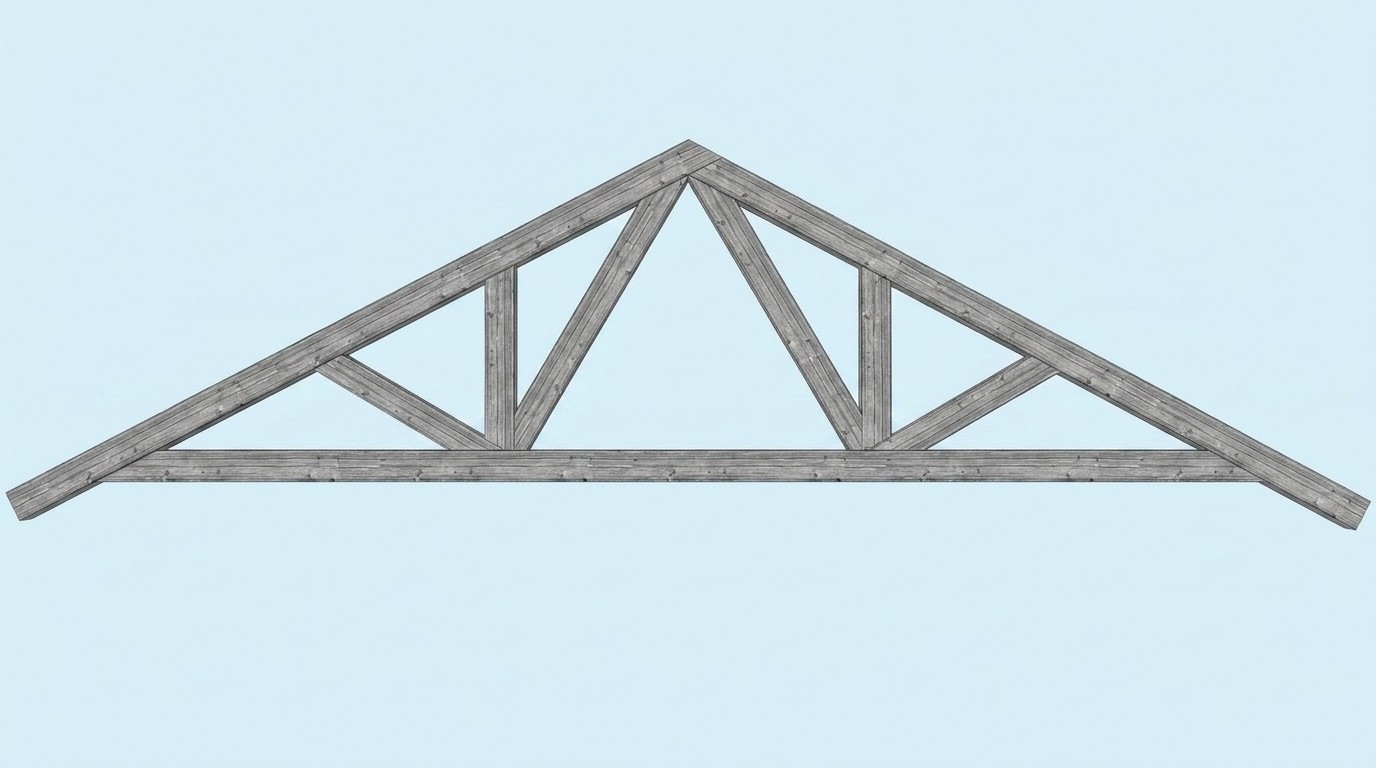
The fan truss uses a web arrangement that spreads from the lower portion of the truss toward several points along the top chord. Its internal layout gives it a different load path from simpler residential trusses.
Fan-style designs can be used for specific loading or structural needs.
They should not be selected simply because a roof has heavy shingles, tile, or snow, since those loads must be calculated as part of the complete truss design.
Trusses That Add Living or Storage Space
Some roof trusses create usable space inside the roof structure. These designs can provide storage or a room above the main living area, but the bottom chord and supporting members must be designed for the additional floor loads.
This can make the truss more expensive than a standard roof truss. It can still be useful when a project needs more interior space without changing the basic footprint of the building.
Attic (Room-in-Attic) Truss

The attic truss, also called a room-in-attic truss, creates an open area inside the roof. The bottom chord and internal framing are designed to support floor loads when the space is intended for occupancy.
This type can work for a bedroom, office, or other planned living areawhen local codes and the complete building design allow it.
It costs more than many standard roof trusses because the truss must support additional loads and provide enough usable space.
Gambrel Truss

The gambrel truss creates the familiar barn-style roof with two different roof slopes. The lower slope is steeper, while the upper slope is shallower.
This shape provides more usable volume near the roof than a simple triangular roof.
It can work well for homes, barns, garages, and storage buildings where extra space inside the roof is useful.
Spread Web Storage Truss

A spread web storage truss changes the internal web layout to create a limited storage area. It is intended for storage rather than a full-time living room unless it has been specifically designed and approved for that use.
This type canwork in garages, sheds, and homes that need room for seasonal items.
The allowable storage load must come from the truss design rather than a general rule.
Matching Trusses to Your Roof Shape
The roof shape often determines which truss arrangement is needed. A gable roof, hip roof, low-slope roof, or single-slope addition each creates different structural requirements.
The truss should be selected as part of the complete roof system. The exterior roof shape, interior ceiling, support walls, openings, loads, and connection details all need to work together.
Gable Truss

The gable truss is used at the end of a gable roof. A typical gable roof has two sloped sides that meet at a ridge, while the end wall forms the triangular shape below the roof.
Gable end trusses can provide a framed surface for the end of the building.
The exact design depends on the wall construction, roof loads, openings, and how the end truss is connected to the rest of the roof.
Hip Truss

A hip roof slopes down toward the walls on all sides.Instead of using only one repeated truss shape, a hip roof usually requires several related truss components that work together.
A girder truss may carry the ends of other trusses and transfer their loads to supporting walls. Jack trusses can then fill the shorter sections near the roof corners.
Because a hip roof can require several truss types and additional framing details, it may cost more than a simple gable roof of similar size. Wind, snow, roof geometry, and connection requirements also affect the final design.
Flat and Parallel Chord Truss

A flat or parallel chord truss has top and bottom chords that run in roughly parallel directions.
It can be used for low-slope roofs and other areas where a conventional pitched roof is not required.
The open web pattern can leave space for some plumbing, electrical, and mechanical runs. Service openings still need to follow the truss design because cutting or drilling truss members without approval can weaken the structure.
Mono Truss

The mono truss has one sloped top chord and resembles half of a conventional gable truss.
It can work well for additions, porches, carports, garages, and other structures with a single roof slope.
Because the design uses one main roof slope, it can suit projects that connect to an existing building. The span, pitch, bearing points, and connection to the existing structure must be determined for the specific project.
Timber vs Steel Roof Trusses: Which One Fits Your Build
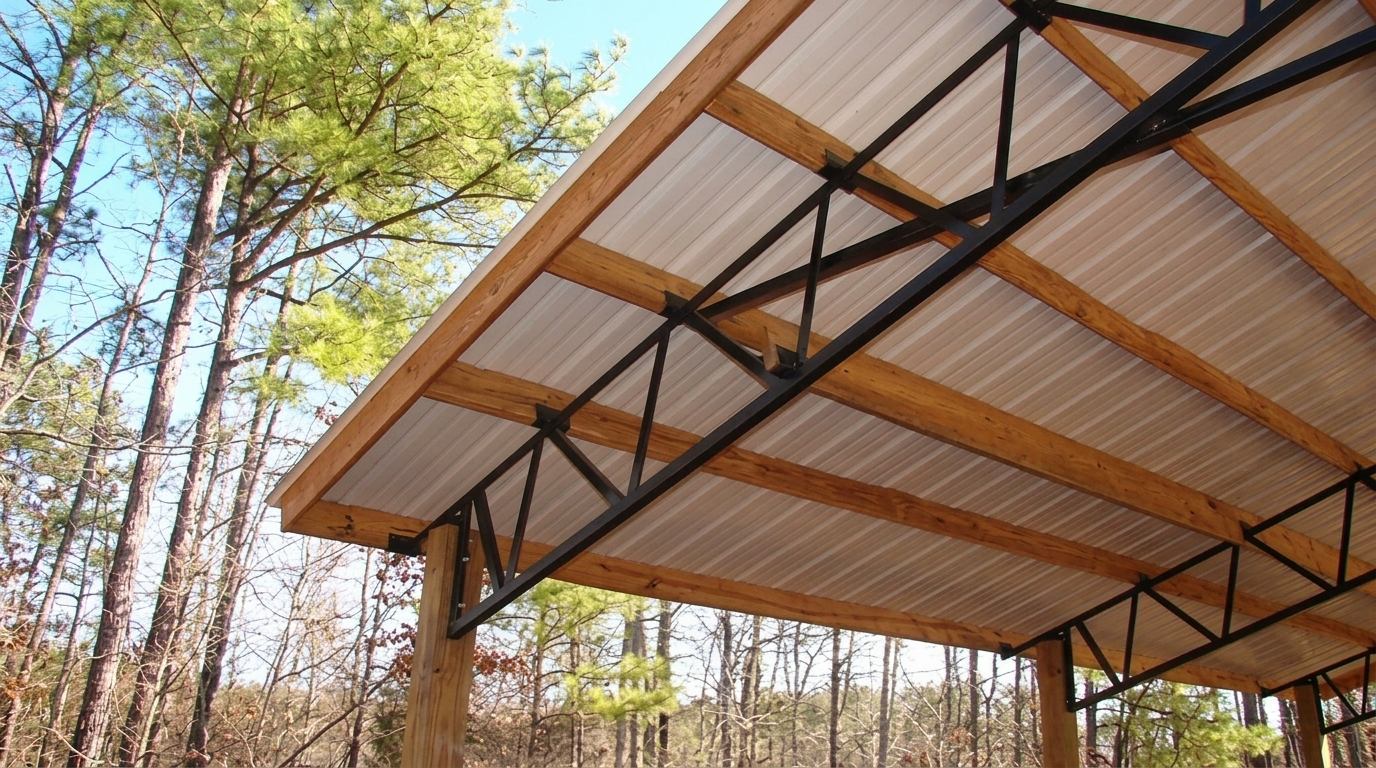
Wood is common in residential roof framing, while steel trusses are often considered for larger spans, agricultural buildings, commercial structures, and other projects where different structural requirements apply.
The choice depends on the building size, loads, span, local availability, installation method, fire requirements, corrosion exposure, and budget. Material alone does not determine which truss is appropriate.
Wood Roof Truss Types

Wood trusses are widely used in homes because they can be manufactured to match common residential roof layouts.
They can be produced in many configurations, including Fink, king post, queen post, scissor, attic, hip, and mono designs.
Wood trusses use metal connector plates or other specified connections at the joints. Their design must account for the lumber species and grade, member sizes, loads, spacing, bracing, and connections shown in the truss drawings.
Steel Roof Truss Types

Steel trusses can be useful where a project needs long spans, different load capacity, or a structural system suited to a larger building.
They are often consideredfor agricultural buildings, large garages, warehouses, arenas, and commercial structures.
Steel does not automatically cost less or perform better than wood in every project. Material prices, fabrication, transportation, corrosion protection, connections, equipment, and installation all affect the final cost.
Roof Truss Span and Cost at a Glance
The table below gives general planning information rather than engineering limits.
Actual spans must come from the truss design for the building, and prices can change with material costs, location, design complexity, and installation requirements.
| Truss Type | Typical Planning Span | Cost Level | Best For |
| King Post | Small spans | Low | Garages, sheds, small additions |
| Mono | Varies | Low | Additions, porches, single-slope roofs |
| Gable | Varies | Low to High | Gable roof ends |
| Queen Post | Small to medium spans | Low to Mid | Additions and exposed framing |
| Fink | Common residential spans | Low | Standard home roofs |
| Spread Web Storage | Varies | Low to Mid | Light storage areas |
| Flat / Parallel Chord | Varies | Mid to High | Low-slope roofs |
| Howe | Varies | Mid to High | Larger structural spans |
| Gambrel | Varies | Mid to High | Barn-style roofs and added roof space |
| Scissor | Varies | Mid to High | Vaulted ceilings |
| Fan | Varies | Mid to High | Specific load and framing needs |
| Hip | Varies by system | High | Hip roof systems |
| Attic | Varies | High | Planned roof-level living space |
| Cathedral | Varies | High | Raised ceiling areas |
| Pratt | Varies | High | Larger open-span structures |
How to Choose the Right Roof Truss
The right truss depends first on the building's structural requirements. Start with the roof span, roof shape, ceiling plan, expected loads, available support points, and project budget.
For a typical home with a standard pitched roof, a Fink truss may be a practical starting point.
A scissor truss suits a vaulted ceiling, an attic truss suits planned roof-level living space, a mono truss can work for a single-slope addition, and a hip truss system suits a hip roof.
Use the following guide as a starting point:
- Standard home roof: Fink truss
- Small structure: King post truss
- Vaulted ceiling: Scissor truss
- Roof-level room: Attic truss
- Single-slope addition: Mono truss
- Gable roof end: Gable truss
- Hip roof: Hip truss system
- Barn-style roof: Gambrel truss
- Low-slope roof: Flat or parallel chord truss
- Large open-span structure: Pratt or Howe design when engineered for the project
The final selection should come from the project's structural design rather than a general span chart. Truss drawings identify the loads, members, connections, bracing, and other details needed for safe installation.
Building Codes and Site Conditions

Understanding the rules and environmental factors that apply to your location is the first step toward choosing a truss that meets structural and legal requirements.
- Local wind, snow, seismic conditions, roof loads, building size, roof pitch, and structure type all influence engineering requirements before construction starts.
- Wood trusses must follow accepted engineering practice under the IRC, with metal-plate-connected wood trusses required to comply with ANSI/TPI 1.
- Snow regions require trusses designed for applicable snow loads; high-wind areas call for specific uplift connections, bracing, and anchorage; seismic regions require designs that account for lateral forces.
- Raised heel trusses create additional space for insulation at the roof edge and should be selected based on roof and energy design needs, not assumed to be universally required.
- Lead times for trusses vary by manufacturer, season, project size, and local demand, so confirm the schedule with your supplier before setting a framing date.
What to Prepare Before Ordering
Having the right information ready before placing an order helps avoid costly changes and keeps the project on schedule.
- Gather building plans, roof dimensions, pitch, span, bearing locations, ceiling design, expected loads, and local code requirements before placing an order.
- Trusses are engineered as a complete structural system, so changes after manufacturing result in added costs and delays.
- Never cut, notch, drill, splice, or alter any truss member without written approval from a qualified design professional, as building codes restrict these modifications due to their effect on load capacity.
- Confirm delivery access and installation needs in advance, since large or long-span trusses often require lifting equipment, proper bracing, and trained installers.
Conclusion
The right roof truss depends on the roof span, roof shape, ceiling plan, loads, material, site conditions, and budget.
Start by deciding how the roof needs to function, then compare the truss types that fit those requirements.
Before ordering, give your plans and project conditions to the truss manufacturer or structural engineer. The final truss design should match the building code, structural loads, connections, and installation requirements for your project.
Found this guide helpful? Share it with someone planning a new build or addition, and leave your roof truss questions in the comments.
Frequently Asked Questions
What is the most common type of roof truss?
Fink trusses are widely used in residential construction because their internal web pattern works well for many standard pitched roofs. The best choice still depends on the project's span, loads, roof shape, and ceiling plan.
Which roof truss is the cheapest?
Simple wood trusses such as king post and some mono or Fink designs can have lower material costs than more complex trusses. Current prices vary by size and supplier, with published material estimates ranging widely by truss type.
Are roof trusses better than rafters?
Neither option is automatically better for every project. Trusses can reduce on-site framing labor and can cover wide areas with fewer interior supports, while rafters can provide more flexibility for certain roof shapes and field-built designs.
How far can a roof truss span without support?
There is no single safe span for every truss type. The allowable span depends on the truss design, lumber, spacing, roof loads, pitch, bearing points, connections, and local conditions, so the engineered truss drawings should control.
Can I cut into a roof truss to add a skylight or run ductwork?
Do not cut, notch, drill, splice, or otherwise alter a truss member without approval from the appropriate design professional. A change can affect the structural capacity of the truss and may require an engineered repair.