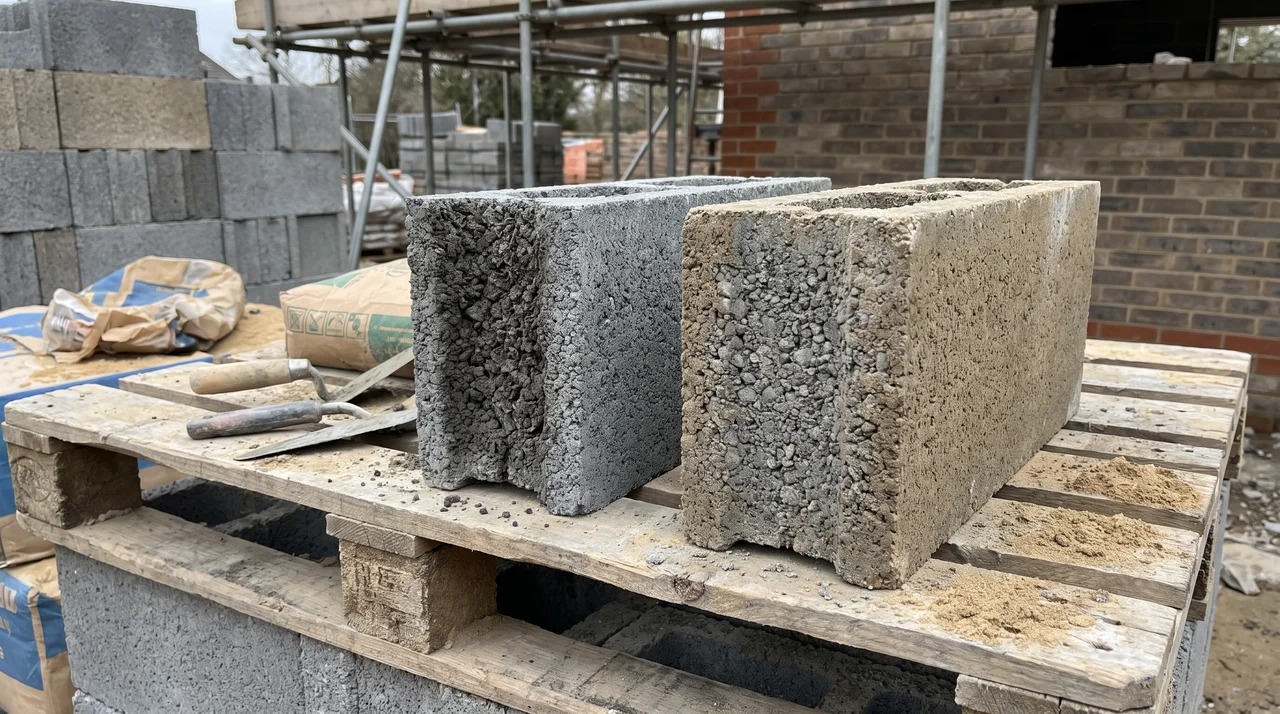
Folks use the terms cinder block vs concrete block like they mean the same thing. They don’t. One is a product that barely exists anymore.
The other is what you’re almost certainly holding when you think you’re holding a cinder block. That mix-up has sent more than a few projects in the wrong direction.
By the end of this, you’ll know exactly what separates the two, why it matters structurally, and which one belongs in your build.
Cinder Block vs. Concrete Block: Key Differences at a Glance
The sections above covered how and why these blocks differ. Here is a quick-reference table pulling those properties together in one place.
|
Property |
Cinder Block |
Concrete Block (CMU) |
|
Aggregate |
Coal ash / cinders |
Sand, gravel, crushed stone |
|
Weight Range |
18–26 lbs |
30–55 lbs |
|
Compressive Strength |
Below 2,000 PSI (variable) |
2,000 PSI+ (ASTM C90) |
|
Porosity |
High, prone to moisture absorption |
Low, denser matrix |
|
Moisture Resistance |
Weak, cracks under freeze-thaw |
Strong |
|
Primary Use |
Non-load-bearing, decorative |
Structural, load-bearing |
Use this as a reference when you are mid-project and need a fast check. For the reasoning behind each row, the sections above have the full picture.
Cinder Block vs. Concrete Block: What Each One Actually Is
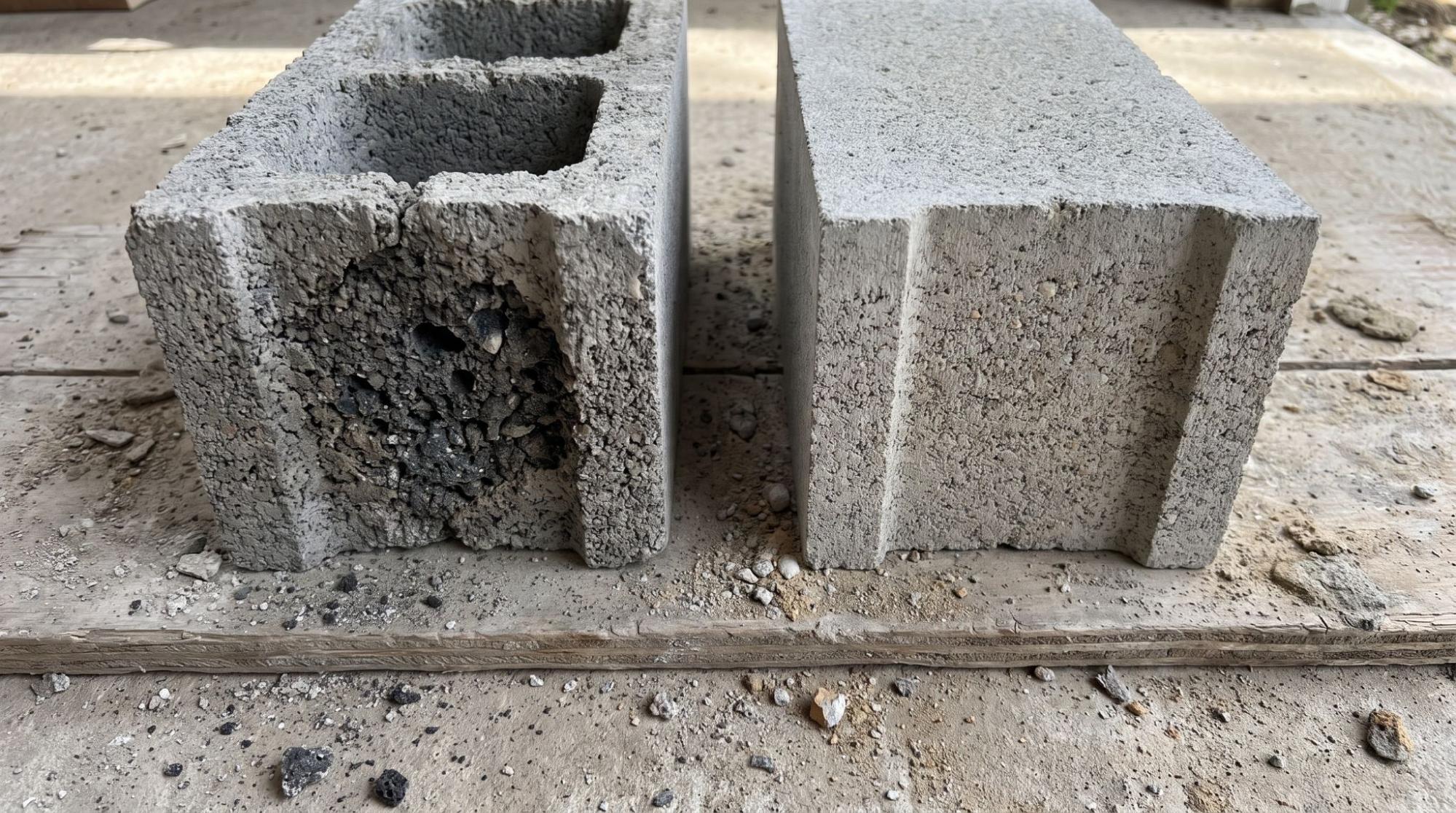
Cinder blocks are made from Portland cement mixed with coal ash or volcanic cinders.
Concrete blocks, called CMUs (Concrete Masonry Units), use Portland cement mixed with sand, gravel, and crushed stone. True cinder blocks are rarely manufactured today.
That distinction matters more than most people realise.
Cinder block production dropped sharply through the mid-20th century. As coal incineration declined, so did the supply of cinders.
Manufacturers moved to denser, more reliable aggregates. By the time most of us started buying blocks at a hardware store, cinder blocks had already left the market.
So if someone calls something a cinder block today, they almost certainly mean a CMU.
The name stuck. The product changed.
Here is why this matters beyond terminology. The aggregate inside a block is not a minor ingredient. It is the thing that determines how heavy the block is, how much load it can carry, and how it behaves when moisture gets in.
Change the aggregate, and everything else changes with it.
That is the thread that runs through every real difference between these two blocks. Before looking at weight, strength, or porosity separately, it helps to understand they all trace back to one thing: what the block is made of on the inside.
How Composition Drives Weight, Strength, and Porosity
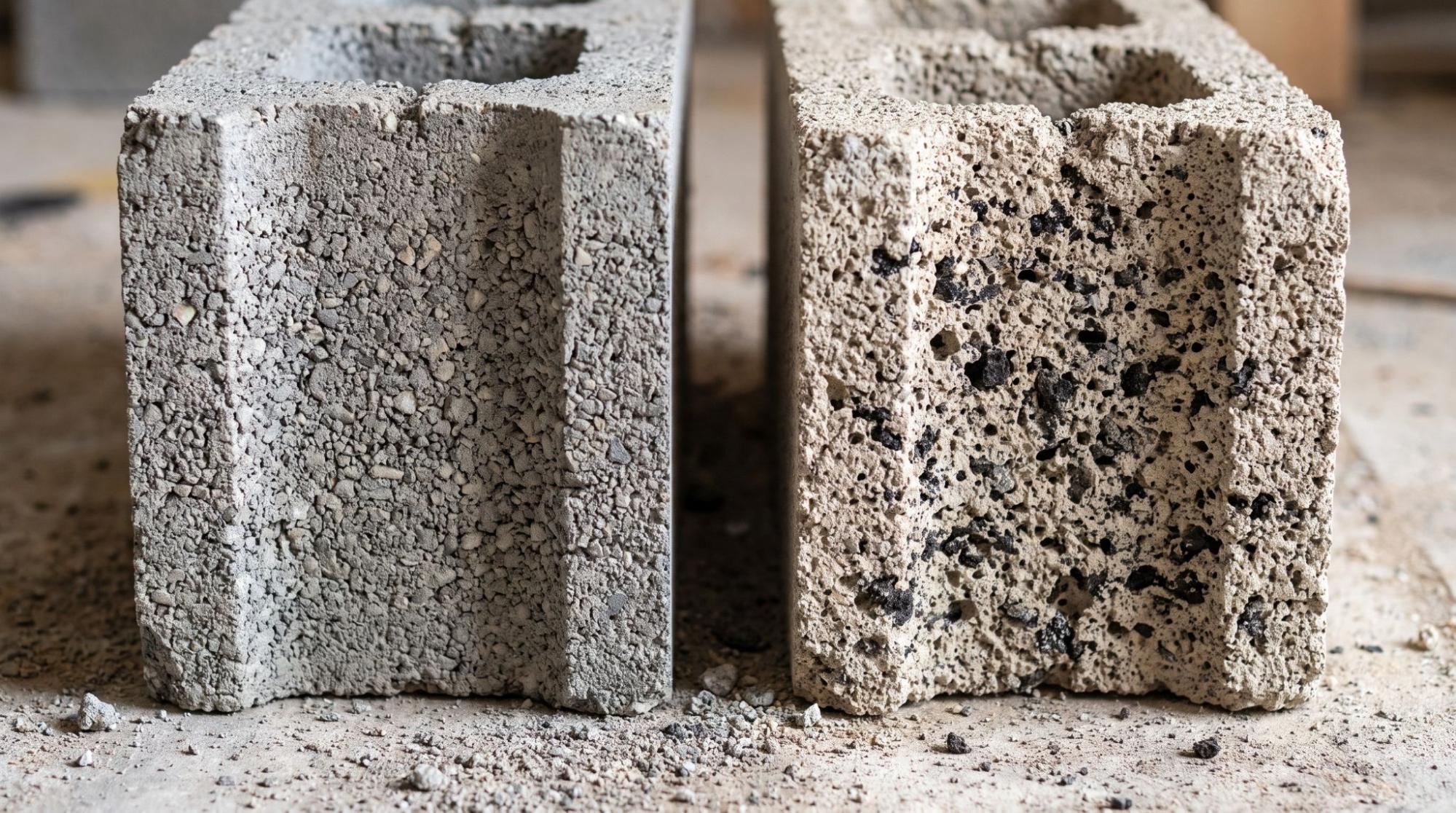
What is inside a block determines how it performs. Aggregate type is not just a material detail. It is the reason two blocks that look nearly identical can behave so differently under load, in wet conditions, or over time.
Weight
Cinder blocks weigh roughly 18 to 26 pounds. Concrete blocks come in at 30 to 55 pounds.
That gap exists because of aggregate density. Coal ash and cinders are light, porous materials. They do not pack tightly. Gravel and crushed stone are dense and compact. When you mix them into a cement matrix, the block inherits that density.
A heavier block is not just harder to carry. It signals a tighter, more solid internal structure. That structure is what makes the weight difference meaningful beyond the job site.
Compressive Strength
Dense aggregate produces a denser matrix. A denser matrix resists compression better. That is the direct line between what a block is made of and how much load it can hold.
Concrete blocks manufactured for structural use must meet ASTM C90. That standard sets a minimum compressive strength of 2,000 PSI. Most structural CMUs exceed it.
Cinder blocks do not reliably reach that threshold. Their porous aggregate creates internal voids. Those voids reduce how much pressure the block can handle before it cracks or fails.
This is not just a performance gap. It is a code gap. In most jurisdictions, ASTM C90 compliance is required for load-bearing masonry. Cinder blocks do not qualify. That makes the choice between these two blocks a regulatory decision, not just a preference.
Porosity and Moisture Behavior
Cinder aggregate absorbs water. Concrete aggregate resists it.
In a dry environment, porosity is mostly an aesthetic issue. In a wet one, it becomes a structural problem. Water that enters a porous block expands when it freezes.
That expansion creates pressure inside the block wall. Over repeated freeze-thaw cycles, the block begins to crack from the inside out.
This happens independently of load. A cinder block used for a simple garden wall in a cold climate will degrade faster than one used for a lightly loaded interior partition in a warm one.
The failure is driven by moisture cycling, not by what is stacked on top of it.
Concrete blocks are far less porous. The dense aggregate leaves fewer pathways for water to enter which is a big part of why CMU wall construction holds up in foundations and retaining walls where ground moisture is a constant presence.
That is why CMUs hold up in foundations and retaining walls where ground moisture is a constant presence.
Which Block to Use and When
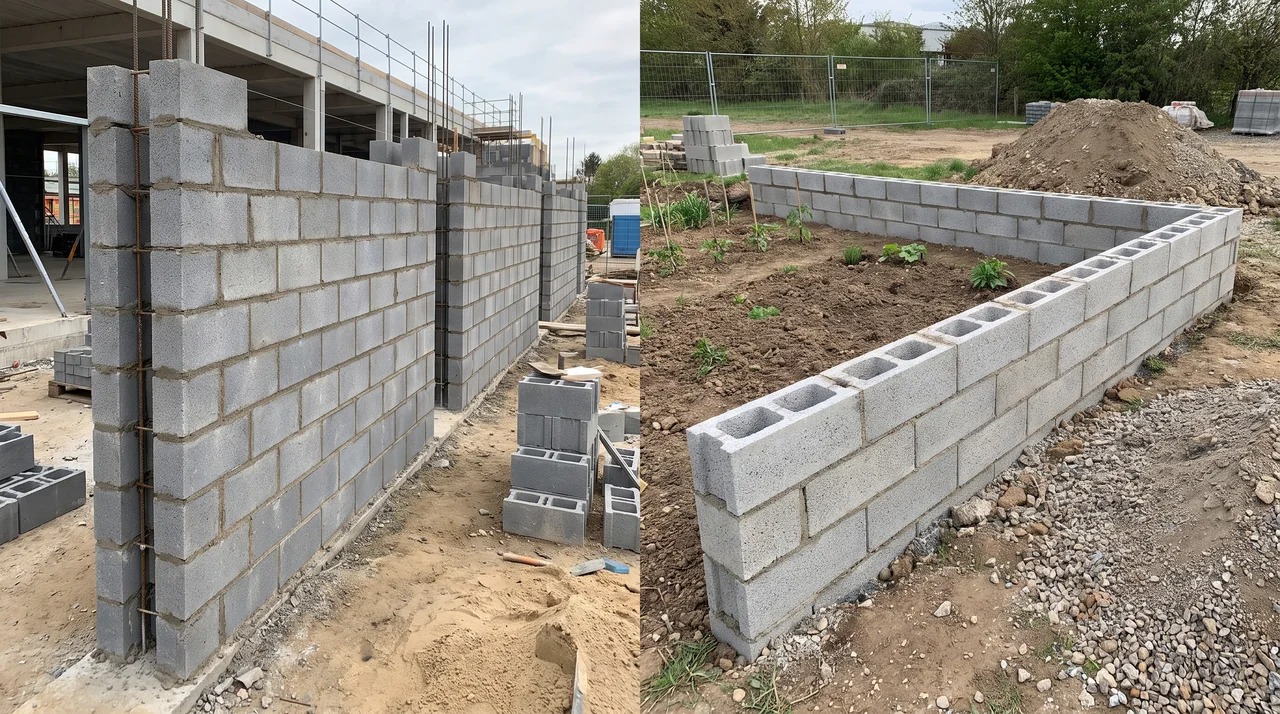
Cinder blocks suit lightweight, non-structural projects. Concrete blocks are required wherever load, moisture, or code compliance is a factor. That boundary is sharper than most buying guides make it seem.
Here is how it plays out in practice.
Non-Load-Bearing and Decorative Uses
Cinder blocks work well for projects where nothing structural depends on them.
Garden walls, raised beds, outdoor furniture bases, and landscaping borders are all reasonable uses. The block carries its own weight and stays relatively dry. In those conditions, its lower density and higher porosity are not problems.
Keep cinder blocks away from sustained moisture exposure, even in decorative builds. A garden border in a wet climate will deteriorate faster than you expect if the blocks are absorbing water through every rain cycle.
Structural and Foundation Uses
For anything load-bearing, use concrete blocks. No exceptions.
Foundations, retaining walls, basement walls, and structural partitions all require blocks that meet ASTM C90.
That standard exists because load-bearing masonry has a failure consequence. A garden wall cracking is an inconvenience. A foundation wall cracking is a safety issue.
Most building inspectors will not sign off on cinder blocks in a structural application.
If you want a broader look at how code categories break down, the different masonry construction types are worth understanding before you finalize your plans.
It is not a matter of the blocks being slightly weaker. They genuinely do not meet the standard the application requires.
Cost and Availability
Cinder blocks sometimes appear cheaper at local suppliers. That price difference narrows when you factor in availability. True cinder blocks are increasingly hard to source. What gets sold under that name is often just a lighter-grade CMU.
Here is what you can realistically expect to pay in the US market:
|
Block Type |
Price Per Block |
Installed Cost (per sq ft) |
|
Standard cinder block (8x8x16 in) |
$1.00 – $2.50 |
$10 – $20 |
|
Standard hollow CMU (8x8x16 in) |
$1.25 – $4.00 |
$15 – $25 |
|
Solid CMU (8x8x16 in) |
$1.90 – $3.50 |
$20 – $35 |
|
Decorative / Split-face CMU |
$2.00 – $5.00 |
$25 – $40+ |
Prices vary by region, order quantity, and delivery distance. Bulk pallet orders typically bring the per-block cost down. Verify with your supplier what you are actually buying before pricing out a project.
The per-block price gap between a true cinder block and a standard CMU is rarely more than a dollar, and the performance difference is significant.
Final Verdict
Honestly, the cinder block vs concrete block confusion isn’t your fault. The name outlived the product by decades.
But now that you know what actually separates them, from the aggregate to the strength standard to how they hold up in wet conditions, you can make the call with confidence. Don’t guess on this one.
If you’re heading into a build and still have questions about which block fits, your local masonry supplier is the fastest way to get a straight answer.
Frequently Asked Questions
When did manufacturers stop making cinder blocks?
Cinder block production declined through the mid-20th century as coal incineration decreased. By the 1970s and 1980s, most manufacturers had shifted entirely to concrete masonry units. Blocks sold today are almost universally CMUs, regardless of what they’re called.
Are cinder blocks and cement blocks the same thing?
Not exactly. Cement blocks use a higher cement ratio with minimal aggregate, making them denser than cinder blocks but different from standard CMUs. In everyday use the terms get mixed together, but cement blocks, cinder blocks, and concrete blocks are technically three distinct products.
How can you tell a cinder block from a concrete block?
True cinder blocks are lighter, darker, and feel rougher or more porous to the touch. If a block weighs under 26 pounds and shows surface pitting, it may be a cinder block. Any block bought new from a supplier today is almost certainly a CMU.
Why do people still call concrete blocks “cinder blocks”?
Cinder blocks dominated American construction through the early-to-mid 20th century and the name attached to the shape rather than the material. As manufacturing shifted to denser aggregates, the colloquial name stayed even though the product had changed.